

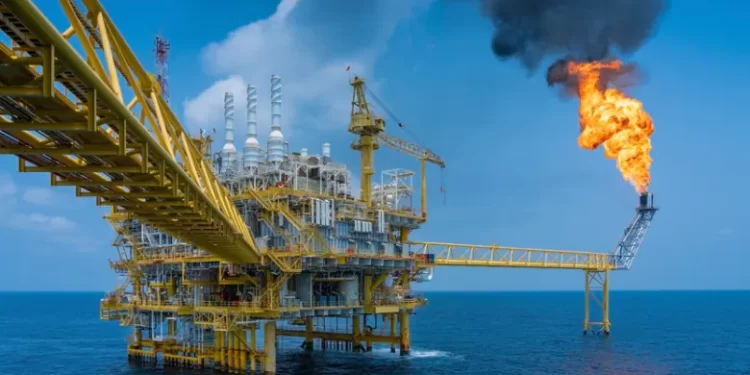
Ghana’s crude oil production has suffered a major decline, falling by 25.9% year-on-year in the first half of 2025, according to the Public Interest and Accountability Committee (PIAC).
The Committee’s 2025 Semi-Annual Report on Petroleum Revenue Management revealed that total crude output from Ghana’s three producing offshore fields — Jubilee, Tweneboa-Enyenra-Ntomme (TEN), and Sankofa-Gye Nyame (SGN) — dropped to 18.42 million barrels, compared to 24.86 million barrels in the same period of 2024.
PIAC attributed the fall mainly to operational shutdowns, natural reservoir decline, and planned maintenance activities across all three major oil fields.
Jubilee Field Suffers Sharpest Decline
The Jubilee Field, Ghana’s flagship oil field, recorded the steepest drop in production — 32.8% — declining from 16.41 million barrels in the first half of 2024 to 11.02 million barrels in the same period of 2025.
Average daily production plunged from 90,755 barrels per day (bbl/d) to 60,898 bbl/d.
According to PIAC, a planned shutdown from March 26 to 31, followed by extended maintenance from April 1 to 8, heavily constrained operations.
January recorded the highest monthly output at 2.40 million barrels, while April’s figure dropped to 1.27 million barrels, the lowest during the period.
TEN Field Output Drops 14%
The TEN Field also recorded a production decline of 14%, producing 2.97 million barrels in the first half of 2025 compared to 3.45 million barrels in 2024.
Average daily output reduced from 19,065 bbl/d to 16,420 bbl/d.
PIAC explained that the fall was caused by a mini-shutdown for flare tip replacement and ongoing reservoir performance challenges.
The highest monthly output was achieved in March (0.51 million barrels), while May saw the lowest at 0.45 million barrels.
SGN Field Records Smallest Decline
Among the three producing fields, the Sankofa-Gye Nyame (SGN) Field experienced the mildest decline — 11.6% — with production dropping from 5.00 million barrels in 2024 to 4.42 million barrels in 2025.
Average daily output decreased from 27,600 bbl/d to 24,463 bbl/d.
PIAC attributed the decline to intermittent operational disruptions and reservoir management difficulties, though these were less severe compared to those affecting Jubilee and TEN.
Revenue and Sector Implications
The report warned that the sustained fall in oil production could have serious revenue implications for Ghana’s economy, particularly in petroleum-related inflows, budget funding, and the Ghana Petroleum Funds.
PIAC further cautioned that if the trend continues, the country could face reduced fiscal space, affecting energy sector investments and the stability of the national budget.
The Committee therefore urged government and industry stakeholders to take immediate corrective measures, including:
-
Addressing operational inefficiencies;
-
Prioritizing reservoir maintenance;
-
Encouraging new investments in the upstream sector; and
-
Enhancing production optimization strategies.
PIAC emphasized that maintaining consistent oil output is essential for long-term energy security and economic sustainability, especially as Ghana navigates the global energy transition and increasing competition for investment in fossil fuels.
Conclusion
Ghana’s declining crude oil output underscores the need for strategic interventions to revitalize the petroleum sector.
PIAC’s findings highlight both the operational and structural challenges confronting the industry, urging swift collaboration between government, operators, and regulators to restore production momentum and safeguard national revenue streams.
